Anime Japanese phrases: which ones can you actually say in real life?
Most anime phrases are real Japanese, but many are in a rough, casual register that sounds rude or theatrical off screen. Reactions like yatta, sugoi, masaka and shimatta are safe with friends. Pronouns like omae and temee, and shouts like kakatte koi, belong to rivals in a story. With strangers, use the polite desu/masu form.
Is the Japanese in anime real Japanese?
Yes. The words and the grammar are real. What is different is the register: characters speak in plain, blunt forms that most adults only use with close friends, and often push them further for drama.
Almost everything in Japanese has a polite form and a casual one. The polite form, built on desu and masu, is for strangers, shop staff and anyone older. The plain form is for friends, family and people your age. Anime, especially action and school stories, lives in the plain form. Then it adds rough pronouns, sentence endings like zo and ze, direct commands and lines delivered as shouts.
None of that is wrong Japanese. It is aimed at a specific person in a specific moment. A line that works between two rivals on a rooftop sounds very different when you say it to someone at a ticket counter.
Some anime speech is not everyday Japanese at all. A samurai character who ends sentences with de gozaru is using an old, formal style that nobody speaks today. Many characters also have a catchphrase or a sentence ending invented just for them. These are writing devices, like a pirate saying "arr" in English: fun to recognise, strange to copy.
Which anime phrases are safe to use in real life?
Short reactions and everyday words are safe. They are casual, so use them with friends and people your age, and switch to a polite version with strangers.
| Phrase | Meaning | When it works |
|---|---|---|
| yatta やった | I did it! Yes! | Any happy moment with friends, or said to yourself. |
| sugoi すごい | amazing, wow | Everywhere. Sugoi desu ne makes it polite enough for anyone. |
| masaka まさか | no way | Real surprise among friends. It is a reaction, not a question. |
| shimatta しまった | oh no, I messed up | Mild. Fine when you drop something or miss your stop. |
| naruhodo なるほど | I see | Common, but it can sound cold after bad news, and a little like grading the speaker when said to a boss or teacher. Sō desu ka is softer. |
| ganbatte 頑張って | good luck, do your best | Before an exam, a match or an interview. Ganbare is the blunter cheer from the sidelines. |
| omoshiroi 面白い | interesting, funny | Everywhere. The situation decides which meaning. |
| mata ne またね | see you | Friends. Mata na, the version you hear in anime, is rougher and more masculine. |
| chotto matte ちょっと待って | wait a second | Friends. With staff or strangers, add kudasai. |
| itadakimasu いただきます | said before eating | Real and expected, at home or at a restaurant. |
Which anime phrases sound rude or strange in real life?
Rough pronouns, insults and battle shouts. They are real words, but outside a story they sound like you are picking a fight or playing a character.
| Phrase | Meaning | Why it is risky |
|---|---|---|
| omae お前 | you (rough) | Only between close friends or rivals. To a stranger it is rude. |
| temee てめえ | you (harsh) | Much harsher than omae. It is trash talk. |
| kisama 貴様 | you (insulting) | It was once respectful and is now an insult, heard mostly in fiction. |
| ore 俺 | I (rough) | Casual and masculine. Fine among friends, arrogant in a job interview. |
| kakatte koi かかってこい | bring it on | A dare to fight. There is no polite version. |
| zamā miro ざまあみろ | serves you right | Gloating. Expect a real argument. |
| kuso くそ | damn | Crude. Not around children, older people or at work. |
| urusai うるさい | noisy; shut up | Said to a person, it means "shut up". |
| baka 馬鹿 | idiot | Teasing between close friends. An insult to anyone else. |
The famous meme line omae wa mō shinde iru (お前はもう死んでいる, "you are already dead") shows the whole pattern in one sentence: a rough pronoun, a plain verb and a threat. It is a good joke between fans and a very odd thing to say to anyone who has not seen the meme.
Why does anime Japanese sound rude in real life?
Four things do it: plain verb forms, rough pronouns, blunt sentence endings and commands. Delivery adds the rest.
- Plain forms instead of desu and masu. Shōbu da ("it's a match") is blunt; shōbu desu is the safer version. Katta ("I won") is a casual brag; kachimashita is polite.
- Pronouns. Everyday Japanese mostly leaves "you" out, or uses the person's name with san. Choosing omae at all is a strong statement. In a manga, a rival switching from omae to kimi is a sign that respect is growing.
- Sentence endings. Zo and ze turn a plain statement into a hero shout: iku zo is "let's go!" with a fist in the air. Na can be a soft ending, as in mata na, or a ban: akirameru na means "don't give up".
- Commands. Okiro ("get up!") is a harsh command form. The polite request is okite kudasai.
Then there is the voice. The same words said quietly and said as a battle cry are two different lines, and a Japanese listener hears the difference at once.
How do you turn an anime line into something you can say?
Drop the rough pronoun, swap the plain form for desu or masu, and remove zo or ze. Most lines then become normal Japanese.
| Anime line | With friends | With anyone |
|---|---|---|
| 行くぞ! Iku zo! | 行こう Ikō | 行きましょう Ikimashō |
| ありがとうな Arigatō na | ありがとう Arigatō | ありがとうございます Arigatō gozaimasu |
| 起きろ! Okiro! | 起きて Okite | 起きてください Okite kudasai |
| 終わりだ Owari da | 終わり Owari | 終わりです Owari desu |
| またやろう Mata yarō | またやろう Mata yarō | またやりましょう Mata yarimashō |
| お前は誰だ Omae wa dare da | 誰? Dare? | どちら様ですか Dochira-sama desu ka |
| またな Mata na | またね Mata ne | 失礼します Shitsurei shimasu (when you leave) |
A simple test: if you would only say it while shouting across a rooftop at your rival, you probably want the right-hand column.
Which phrases matter more than anime lines on a trip to Japan?
A handful of plain, polite words will do more for you than any battle line. Sumimasen, arigatō gozaimasu, onegaishimasu and daijōbu desu cover most of a day.
- sumimasen (すみません): excuse me, sorry and a quiet thank you in one word. It gets a waiter's attention and clears a path on a crowded train.
- arigatō gozaimasu (ありがとうございます): the polite thank you for staff and strangers.
- onegaishimasu (お願いします): please, when you ask for a service or hand something over.
- daijōbu desu (大丈夫です): "it's fine". With a small wave of the hand, it is a polite no to a bag or a receipt.
- mō ichido onegaishimasu (もう一度お願いします): once more, please. Much better than a sharp nani? when you did not catch something.
- wakarimasen (分かりません): I don't understand.
How can you practise anime Japanese without sounding rude?
Treat rough lines as acting, not as conversation. Learn them to understand what you watch and read, and say them out loud in role play, where the attitude is the point.
- Learn in pairs. For every rough word, learn the neutral one next to it: omae and kimi (or the person's name), mata na and mata ne, ganbare and ganbatte.
- Ask who is talking to whom. A rough line between equals in the middle of a fight is rough for a reason. The same line to a teacher would be a different story.
- Say lines with their mood. A shout said flat sounds wrong even when every sound is right. Practise the attitude, not only the words.
- Watch with Japanese subtitles once you can read kana. You see the exact words the character uses, not a loose English rewrite. If kana are still new, start with our guide to learning hiragana fast.
Where Matcha Chat helps
Matcha Chat has a chapter for exactly this register, called Manga Talk. It teaches 56 rough, casual words and phrases from rival scenes, from omae and kakatte koi to nakanaka yaru ("not bad at all"). Each one comes with a note on when it is used and a "watch out" note on where it goes wrong.
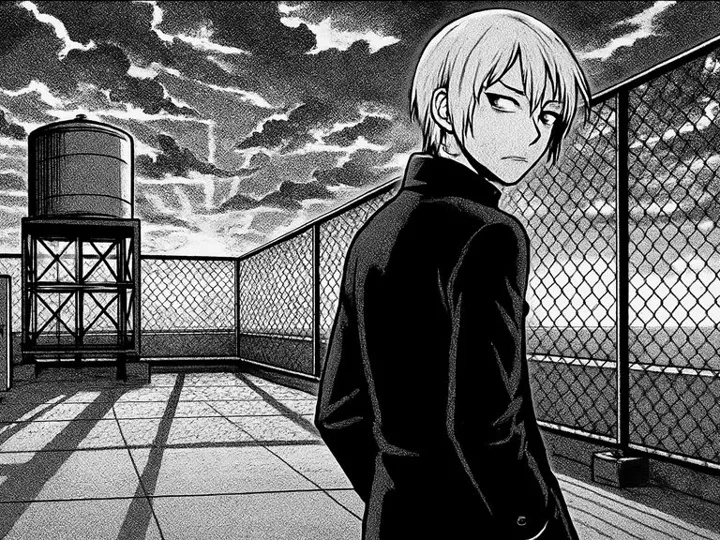
The comic strips are drawn for the app: Kai and Ren on a rooftop at sunset, with Mio shouting from the stairwell. You read a strip panel by panel and learn its lines. Then you pick Kai or Ren and play the scene like karaoke over four rounds: full lines, then one word missing, then two, then from memory. The app scores the sounds and the mood, so a battle cry said like a remark is marked down. Register cards put polite and casual forms side by side, and the other thirteen chapters cover the everyday Japanese you need at the konbini, the station and the ramen counter.
On Android. Free for your first week with every chapter open, then one purchase and no subscription.
Frequently asked questions
Is it rude to say omae in Japan?
Usually, yes, unless you are with close friends or family who talk that way. Omae is a rough "you". With anyone else, use their name with san, or leave "you" out, which is what Japanese speakers normally do.
Can I say ore instead of watashi?
Ore is a casual, masculine "I" used among friends. In shops, at work or with anyone older, it sounds arrogant. Watashi works for everyone in every situation, so it is the safe default.
What does nani mean, and is it rude?
Nani means "what". A sharp "nani?!" is fine with friends. To ask a stranger to repeat something, say sumimasen, mō ichido onegaishimasu: sorry, once more, please.
Is baka a swear word?
Baka means "idiot". Between close friends it can be teasing, but said to anyone else it is an insult. It is milder than most English swear words, and it still hurts.
Is sugoi polite?
Sugoi is casual but not rude, and you will hear it everywhere. Say sugoi desu ne to make it polite enough for anyone.
Can you learn Japanese from anime?
Anime is good for listening, rhythm and motivation, and the words are real. It is a weak guide to politeness, because most lines are casual or rough. Pair it with something that teaches the polite desu/masu forms and when to use each.