How to learn hiragana fast: a 7-day plan that sticks
The fastest way to learn hiragana is one row of the chart at a time, sound first, with a picture for each shape and real words to read straight away. Learn the 46 basic characters over five days, then the marks and small kana. Review a little every day; many learners can read them all within two weeks.
How many hiragana are there?
There are 46 basic hiragana. Two small marks and three small kana build every other sound in Japanese from them.
The 46 are five vowels, forty consonant-plus-vowel pairs and ん, the only consonant that stands alone. Add two dots (dakuten) or a small circle (handakuten) and you get 25 more sounds, such as が (ga) and ぱ (pa). Small ゃ ゅ ょ combine with other kana into sounds like きゃ (kya), and a small っ doubles the next consonant. So you are not learning a hundred shapes. You are learning 46, plus a few rules that change them.
| Row | a | i | u | e | o |
|---|---|---|---|---|---|
| – | あa | いi | うu | えe | おo |
| k | かka | きki | くku | けke | こko |
| s | さsa | しshi | すsu | せse | そso |
| t | たta | ちchi | つtsu | てte | とto |
| n | なna | にni | ぬnu | ねne | のno |
| h | はha | ひhi | ふfu | へhe | ほho |
| m | まma | みmi | むmu | めme | もmo |
| y | やya | ゆyu | よyo | ||
| r | らra | りri | るru | れre | ろro |
| w | わwa | をo | |||
| n | んn |
What order should you learn hiragana in?
Follow the chart: the five vowels first, then each consonant row in order. Every row is the same five vowels with a consonant in front, so each new row is mostly familiar.
Get the vowels right before anything else, because every other kana ends in one of them. They are short and pure, and they never glide:
- あ a: the a in "father", cut short.
- い i: the ee in "see", clipped to one beat.
- う u: the oo in "food", with flat lips instead of pushed-out ones.
- え e: the e in "bed", never the ay in "say".
- お o: the o in "for", stopped before the lips close.
Then watch for five spellings that break the pattern: し is shi, ち is chi, つ is tsu, ふ is fu, and を is said o. Two sounds have no English match: the ら row is a single quick tap of the tongue, like the tt in an American "butter", and ふ is blown gently between the lips with no teeth involved.
What is the fastest way to memorise each hiragana?
Link each shape to its sound with a quick picture, say it out loud, read it inside real words, and review it at growing gaps.
Say it, don't just look at it
Every kana is one sound and one even beat. Say it aloud each time you see it, so the shape connects to a sound, not to a Latin letter. This also starts your accent off right: すみません is five even beats, su-mi-ma-se-n, with no syllable stressed.
Give each shape a picture
A silly picture that links the shape to the sound sticks better than staring at the chart. A few examples:
- つ (tsu) curls like a wave: tsunami.
- し (shi) hangs like a fishhook: she is fishing.
- く (ku) opens like a bird's beak: cuckoo.
- へ (he) is a little hill: hey, a hill.
- の (no) is a circle with a line through it, like a "no entry" sign.
The best pictures are the ones you make up yourself. Spend ten seconds on each one, then move on.
Read real words straight away
After each row, read words made only from the kana you know. Recognising ねこ as "cat" is far more rewarding than reciting a chart, and it is the skill you actually need.
| After these rows | Words you can read |
|---|---|
| あ か | あか aka (red), あき aki (autumn), かお kao (face), こえ koe (voice), ここ koko (here) |
| さ た | すし sushi, さけ sake, つき tsuki (moon), たこ tako (octopus), そと soto (outside) |
| な は | ねこ neko (cat), いぬ inu (dog), はな hana (flower), ひと hito (person), ほし hoshi (star) |
| ま や ら わ ん | やま yama (mountain), ゆき yuki (snow), さくら sakura (cherry blossom), わたし watashi (I), にほん nihon (Japan) |
Review at growing gaps
Go over a row at the end of the session, again the next day, then after three days and after a week. Five minutes of review beats an hour of cramming. A flashcard app with spaced repetition does the timing for you.
Write each one a few times
Writing by hand makes you notice the details that separate similar shapes, like the loop at the end of ぬ or the extra line in ほ. You do not need perfect handwriting to read, but a few written copies help the shapes stick.
A 7-day plan to learn hiragana
Two rows a day for five days, then two days for the extras. About 20 minutes a day is enough.
| Day | Learn | Watch for |
|---|---|---|
| 1 | Vowels and the k row: あいうえお かきくけこ | Pure, short vowels |
| 2 | The s and t rows: さしすせそ たちつてと | し shi, ち chi, つ tsu |
| 3 | The n and h rows: なにぬねの はひふへほ | ふ fu is blown, no teeth |
| 4 | The m, y and r rows: まみむめも やゆよ らりるれろ | The r is a tongue tap |
| 5 | わ を ん, then review all 46 | を is said o; ん is a full beat |
| 6 | Dakuten and handakuten: が ざ だ ば ぱ rows | Two dots voice the sound |
| 7 | Small っ, small ゃ ゅ ょ, long vowels | きって, きょう, おばあさん |
Start each day with a three-minute review of the days before. If a day feels like too much, split it in two. The order matters more than the speed.
Which hiragana are easiest to confuse?
A handful of look-alike pairs cause most mistakes. Learn the one detail that separates each pair.
| Pair | How to tell them apart |
|---|---|
| ぬ / め nu / me | ぬ ends in a small loop; め does not. |
| る / ろ ru / ro | る has a loop at the bottom; ろ does not. |
| ね / れ / わ ne / re / wa | Same left stroke. ね ends in a loop, れ ends in a kick outwards, わ ends in a round curve. |
| は / ほ ha / ho | ほ has an extra line across the top. |
| き / さ ki / sa | き has two crossing lines; さ has one. |
| さ / ち sa / chi | Near mirror images. ち bulges to the right, like a 5; さ bulges to the left. |
| い / り i / ri | In い the left stroke is longer; in り the right stroke is longer and runs down. |
| あ / お a / o | お has a separate short dash at the top right; あ does not. |
What comes after the basic 46?
Three small additions: marks that voice a sound, a small っ for a pause, and small ゃ ゅ ょ that fold two kana into one beat. Each one changes the meaning of a word.
- Dakuten (two dots) turn k into g, s into z, t into d and h into b. Handakuten (a small circle) turns h into p. かき kaki is a persimmon; かぎ kagi is a key. てんき tenki is weather; でんき denki is electricity.
- Small っ is a full beat of silence before the next consonant. きて kite means "come"; きって kitte is a stamp. おと oto is a sound; おっと otto is a husband.
- Small ゃ ゅ ょ join the kana before them into one beat: きょう kyō (today), でんしゃ densha (train), しゃしん shashin (photo).
- Long vowels are held for two beats. おばさん obasan is an aunt; おばあさん obāsan is a grandmother. ここ koko is "here"; こうこう kōkō is a high school.
Should you learn katakana at the same time?
Learn hiragana first, then katakana straight after. Katakana writes the same sounds, so the second set usually goes faster.
Katakana is used mostly for words from other languages, which makes it the script of menus and shop signs: コンビニ konbini, ラーメン rāmen, コーヒー kōhī, タクシー takushī. The long bar ー holds the vowel for two beats. Watch two look-alike pairs: in シ (shi) and ン (n) the last stroke sweeps up, while in ツ (tsu) and ソ (so) it sweeps down.
Once you can read both scripts, stop leaning on romaji. Our guide on when to stop using romaji covers that switch.
Where Matcha Chat helps
Matcha Chat's Kana Lab follows the same order as this plan: the five vowels; the か さ た な rows; は ま や ら わ and ん; then dakuten, small っ and combinations; and finally katakana for signs and menus. That is 25 short sound units across six levels. Each sound comes with an English bridge (the Japanese a is the a in "father", cut short), where to put your mouth, and real words that use it, plus pairs like kaki and kagi so you hear what the two dots change.
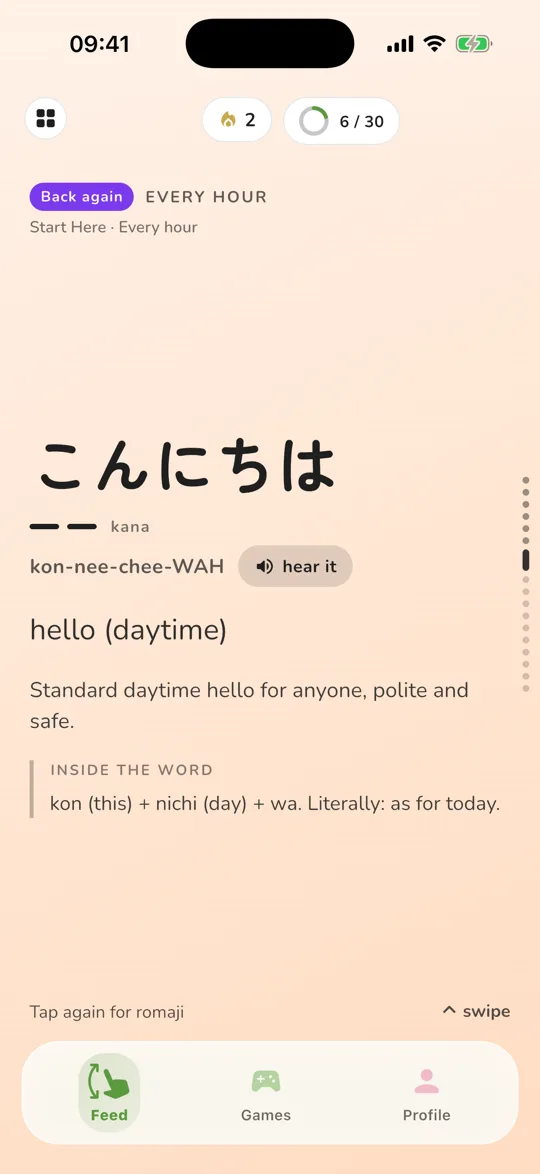
In the main feed, every word starts in romaji; tap it to see it in kana. On Say It cards you say the word and get a score out of 100 that names the sound to fix. The app teaches you to read and say kana. It does not teach handwriting or stroke order, so keep a notebook for that.
On Android. Free for your first week with every chapter open, then one purchase and no subscription.
Frequently asked questions
How long does it take to learn hiragana?
Many learners can recognise all 46 basic hiragana after one to two weeks of about 20 minutes a day. Reading them quickly takes longer and comes from reading kana every day.
Should I learn hiragana or katakana first?
Hiragana. It writes grammar, particles and native words, so you meet it in every sentence. Katakana, used mostly for loanwords, is quicker to learn once you know the sounds.
Do I need to learn to write hiragana?
Not to read it. But writing each character a few times makes you notice the details that tell similar shapes apart, so most learners find it speeds up recognition.
How many hiragana are there?
There are 46 basic hiragana. The voicing marks add 25 more sounds, and small ゃ, ゅ and ょ make combinations such as きゃ (kya) and しょ (sho).
Can I learn hiragana in one day?
You can see all 46 in a day, but most of them will not stay. Spread them over five days with a short review each day and they will.
What is the hardest part of hiragana?
Look-alike pairs such as ぬ and め or る and ろ, and the sounds that do not match English spelling: し (shi), ち (chi), つ (tsu), ふ (fu), and を, which is said o.