When should you stop using romaji to learn Japanese?
Stop relying on romaji as soon as you can read hiragana, which many learners manage in one to two weeks. Use romaji at the very start to get speaking, then read new words in kana and check the romaji only when you are stuck. Keep it for typing: on a computer, Japanese is usually typed in romaji.
What is romaji?
Romaji is Japanese written in the Latin alphabet. It is a tool for people who cannot read Japanese script yet, not the way Japanese is normally written.
Written Japanese mixes three scripts. Hiragana carries grammar, particles and many native words. Katakana carries words borrowed from other languages, such as コンビニ (konbini, convenience store). Kanji are characters that carry meaning, such as 駅 (eki, station). A normal sentence uses all three. Romaji flattens all of that into one line of Latin letters.
There is more than one way to write romaji. The two you will meet most are Hepburn and Kunrei-shiki:
| Kana | Hepburn | Kunrei-shiki |
|---|---|---|
| し | shi | si |
| ち | chi | ti |
| つ | tsu | tu |
| ふ | fu | hu |
| じ | ji | zi |
| しゃ | sha | sya |
Hepburn spells sounds the way an English speaker expects to say them, which is why most courses for English speakers use it. Careful Hepburn marks long vowels with a macron: Tōkyō, arigatō.
Is it bad to learn Japanese with romaji?
No, not at the start. Romaji lets you say real words on your first day. The cost comes when you stay on it, because it hides things that kana show plainly.
Japanese has only five vowels and a small set of sounds, so romaji gets you speaking quickly. If your first goal is to order at a ramen counter or ask for directions, starting in romaji is a reasonable choice. The trouble starts weeks later, when romaji has become the way you picture every word. Then each real sentence you meet has to be translated twice: from kana into romaji in your head, and then into meaning.
What does romaji hide that kana show?
Particles that are spelled differently from how they sound, which vowels are long, and where the beats fall. Kana make all three visible.
Particles
Three particles are written with one kana and said with another. The topic particle は is said wa. The object particle を is said o. The direction particle へ is said e. Romaji writes the sound, so konnichiwa looks simple, while the kana こんにちは ends in は. If you have only seen romaji, the first real sentence you read looks misspelled.
Long vowels
A long ō can be written おう, as in とうきょう (Tōkyō), or おお, as in おおきい (ōkii, big). Many romaji texts drop the macron completely, so Tokyo, Toukyou and Tōkyō are all the same word. Worse, obasan (おばさん, aunt) and obāsan (おばあさん, grandmother) look identical once the macron is gone.
Beats
Japanese is timed in even beats, roughly one per kana. ん takes a full beat of its own, and a small っ is a beat of silence: きて (kite, come) against きって (kitte, stamp). In romaji, kinen (きねん, commemoration) and kin'en (きんえん, no smoking) differ only by an apostrophe that many writers leave out. In kana, you can count the beats.
English habits
Romaji looks like English, so English pronunciation creeps in: a stressed syllable, vowels that glide, an English r. Desu turns into "day-soo" instead of a short "dess". Kana do not trigger those habits, because your brain has no English reading for them.
| Romaji | Kana | What the kana show |
|---|---|---|
| konnichiwa | こんにちは | The last sound is the particle は |
| ocha o nomimasu | おちゃをのみます | The o is the particle を |
| eki e ikimasu | えきへいきます | The second e is the particle へ |
| Tōkyō | とうきょう | Each ō is written おう |
| ōkii | おおきい | This ō is written おお |
| kitte | きって | Small っ is a silent beat |
| kin'en | きんえん | ん is a beat of its own |
When should you stop using romaji?
Switch as soon as you can read hiragana, even slowly. From then on, read in kana first and treat romaji as a hint you check after you try.
| Stage | What you read | Job of romaji |
|---|---|---|
| First days | Romaji, while you learn hiragana row by row | Your way in, mostly for speaking |
| Hiragana learned | New words in hiragana | A check after you try |
| Katakana learned | Loanwords like コーヒー (kōhī, coffee) | Rarely needed |
| Kanji arriving | Kanji with small kana printed above them (furigana) | Gone, except for typing |
Signs you are ready to switch:
- You can read all 46 basic hiragana, even if you still have to think about some.
- You notice your eyes jump to the romaji and skip the kana.
- You are moving from single words to whole sentences.
- You are learning words you will meet in writing: menus, signs, manga.
Slow kana reading is normal. Speed comes from reading, and you cannot build it while the romaji is still there to lean on.
How do you switch from romaji to kana without stalling?
Start with words you can already say, cover the romaji, and accept slow reading for a couple of weeks.
- Start with words you already know. If you can say arigatō and sumimasen, reading ありがとう and すみません is decoding, not learning two things at once.
- Cover the romaji. Try the kana first. Look at the romaji only to check yourself.
- Read out loud, one beat per kana. Saying すみません as five even beats, su-mi-ma-se-n, trains reading and pronunciation together.
- Learn katakana next. Start with the loanwords you will see first in Japan: konbini, takushī (taxi), kōhī (coffee).
- Use furigana for kanji. Children's books, many manga and most learner materials print small kana next to kanji, so you can keep reading while kanji arrive.
- Add a Japanese keyboard. Typing in romaji and watching it turn into kana, and then kanji, is a reading drill you do every time you send a message.
New to kana? Our 7-day hiragana plan takes you through all 46 in order.
Do Japanese people use romaji?
Rarely for reading, often for typing. Books, manga, apps and most menus are written in kana and kanji.
You will see romaji on station signs and road signs, on maps and in tourist areas, because it helps visitors. On computers, most people in Japan type Japanese through romaji input: they type the sounds in Latin letters and the keyboard turns them into kana and kanji. On phones, many people use a kana keyboard instead. So romaji never fully disappears from your life. It just stops being how you read.
Where Matcha Chat helps
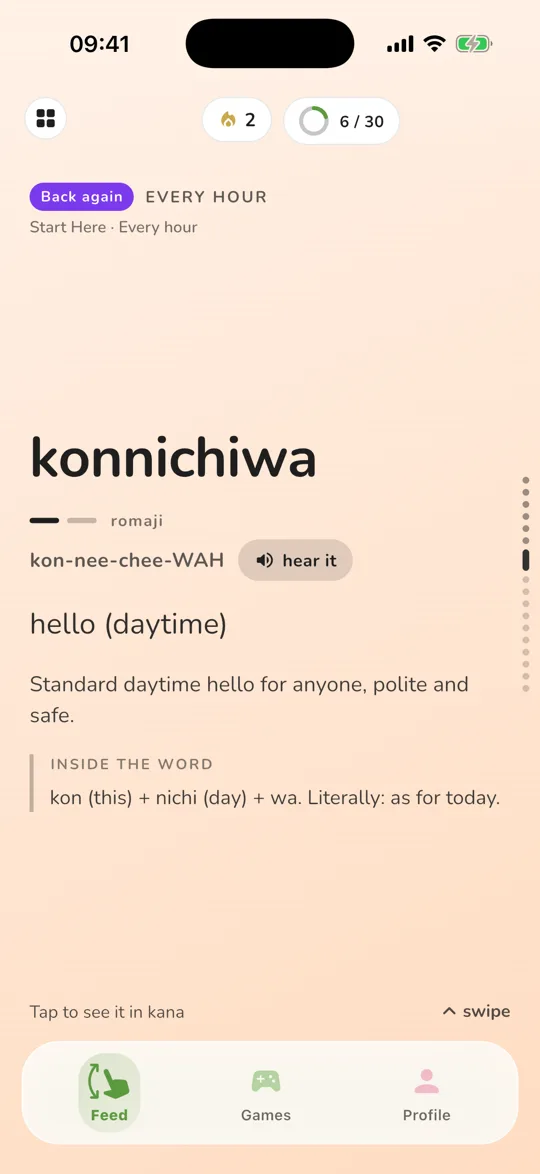
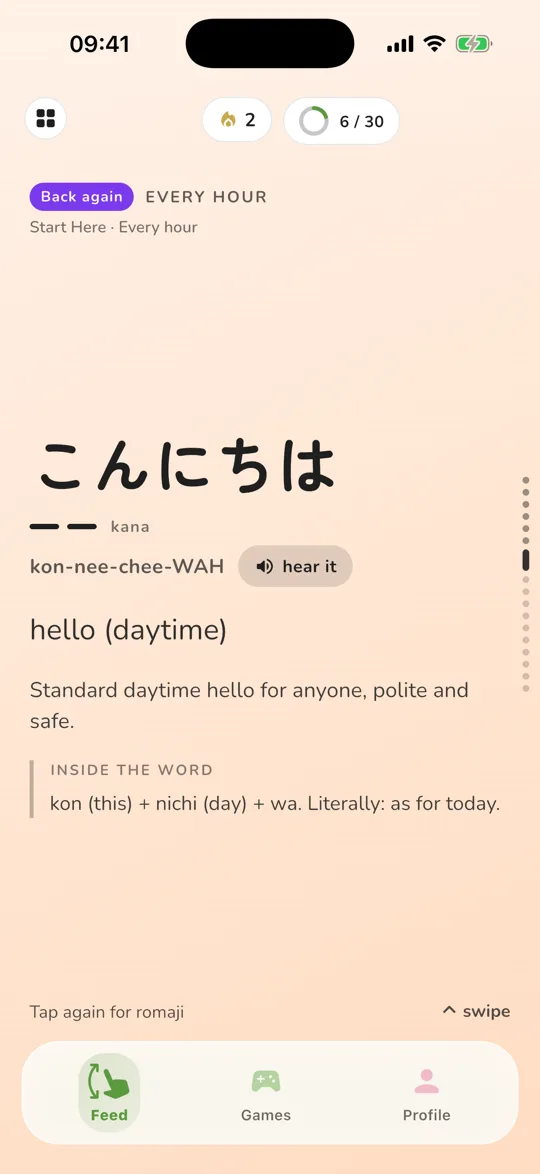
Matcha Chat is built around this switch. Every word arrives in Hepburn romaji with macrons, so you can say it on your first day. Tap the word and it flips to kana; tap again for kanji. You meet the script one word at a time, inside words you already know how to say.
The Kana Lab teaches the sounds behind the letters one row at a time, from the five vowels to small っ and katakana on signs. Each sound has an English bridge (the Japanese r is the quick tap in an American "butter") and real words that use it. Matcha Chat is a speaking-first app, so if your main goal is reading novels, pair it with a reading course.
On Android. Free for your first week with every chapter open, then one purchase and no subscription.
Frequently asked questions
Should I skip romaji completely?
You can, but you do not have to. Romaji is useful for your first days of speaking and for typing. The mistake is reading it for months instead of moving to kana.
Why is konnichiwa written with は and not わ?
Because the wa is the topic particle は. Konnichiwa started as the opening of a sentence meaning roughly "as for today", and the particle kept its spelling: こんにちは. Konbanwa (こんばんは, good evening) works the same way.
Which romaji system should I learn?
Hepburn. Most English-language courses and dictionaries use it, as do most station signs, and it spells sounds the way an English speaker expects: shi, chi, tsu, fu.
How long does it take to stop needing romaji?
Many learners can read hiragana after one to two weeks of short daily practice, and katakana takes about the same again. Reading smoothly takes longer, and it only comes from reading kana every day.
Is romaji enough for a trip to Japan?
For speaking, mostly yes: you can learn useful phrases from romaji. For reading, no. Station names have romaji, but many menus, shop signs and labels do not. Katakana alone unlocks a lot of menu items, because loanwords like kōhī (コーヒー, coffee) are written in it.
How do you type Japanese with romaji?
Add a Japanese keyboard on your phone or computer and type the sounds in romaji: typing sumimasen gives すみません. Press space to convert to kanji where you need it. For を, type wo. For ん before a vowel, type nn.